
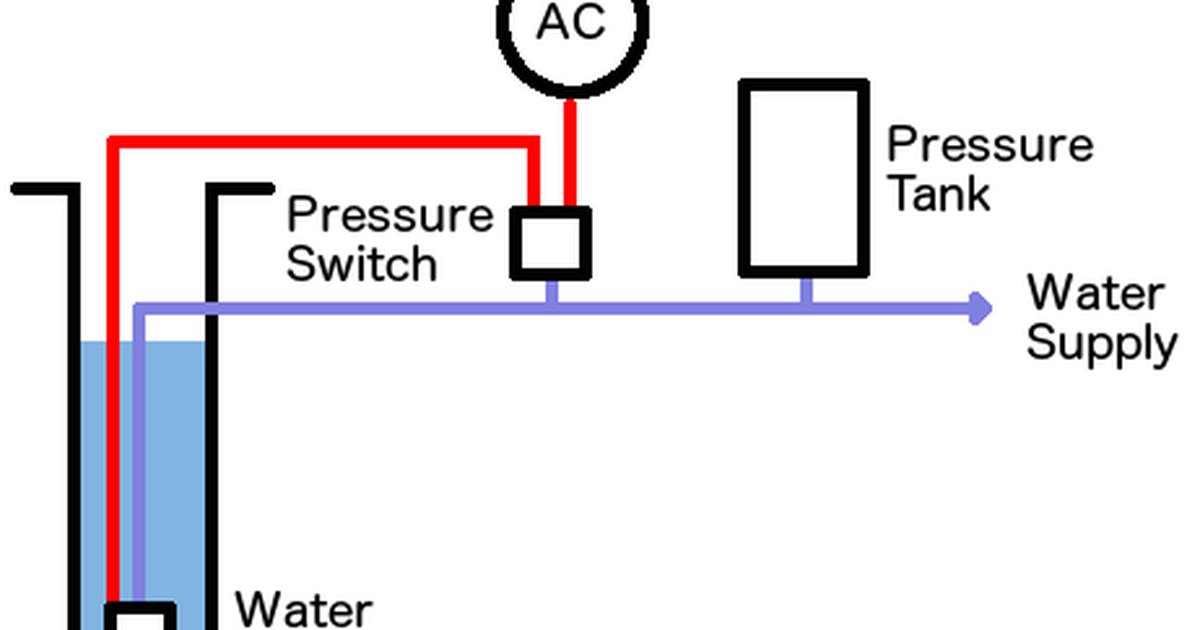

Two of the most common well-pump calls we run in Central Florida sit at opposite ends of the spectrum: a pump that runs constantly and never builds full pressure, and a pump that will not turn on at all. Both have a handful of likely causes. Both have a small set of safe homeowner checks and a clear line beyond which you should call a contractor. This article walks both patterns the way we walk them on a real service call.
The Two Patterns in Plain English
If you stand by your pressure tank and listen, a healthy well pump cycles. The standard Central Florida residential pressure switch is set to either 30/50 psi or 40/60 psi. On a 30/50 setting the pump turns on at 30 psi (cut-in) and stops at 50 psi (cut-out), giving the house a 20 psi swing across the tank's drawdown volume. On a 40/60 setting that swing widens to 20 psi between 40 and 60 psi, which is what most new construction now defaults to because faucet aerators and washing machines run better above 40 psi. Most older wells we service still sit on 30/50. Either way, a healthy cycle on a 4-bedroom home runs the pump for 1 to 3 minutes per fill, with the tank then holding pressure for several minutes of fixture use before the pump fires again. When that rhythm breaks, the failure usually falls into one of two camps:
- Constant running: the pump turns on and never turns off. Pressure may climb slowly, may plateau, or may never reach cut-out. Water at the fixtures is weak, intermittent, or absent entirely.
- No start at all: nothing happens when pressure should be calling the pump on. The pressure gauge reads zero or low. Faucets give nothing or air.
Different causes, but both are diagnosable.
Pattern A: The Pump That Will Not Stop Running
Cause 1: Failed Check Valve
The check valve sits at the top of the pump and prevents water from flowing back down the drop pipe when the pump shuts off. When the check valve fails open, water drains back into the well every time the pump stops. The pump fires again to refill the line and immediately drains again. Net result: a pump that runs continuously, never quite catching up. Some failure modes show as a pump that builds pressure slowly but loses it the moment usage stops.
Cause 2: Hole in the Drop Pipe
The drop pipe is the vertical run from the pump up to the wellhead. PVC pipe can crack under thermal stress or impact during a pump pull; galvanized pipe can corrode through. Either way, water exits the system below the surface and the pump pumps without ever pressurizing the house side.
Cause 3: Clogged Pump Intake
On Central Florida wells in karst geology, fine sediment from a shifting borehole can clog the pump screen. The pump runs at amperage but pulls very little water. We see this most commonly on wells with declining pressure that was incorrectly diagnosed as a worn pump.
Cause 4: Pressure Switch Stuck Closed
The pressure switch is the small device on the pressure tank that signals the pump to run. When the contacts inside the switch corrode or get stuck closed, the switch never tells the pump to stop. On a hot Central Florida afternoon with lightning in the area, this is one of our most common failures.
Cause 5: Lost Prime (Jet Pumps Only)
Above-ground jet pumps draw water by creating vacuum. If air enters the suction line (failed foot valve, cracked suction pipe, drop in water table), the pump loses prime and spins without moving water. Submersible pumps do not have this problem because they sit below the water level and push water up.
Pattern B: The Pump That Will Not Start
Cause 1: Tripped Breaker
Always the first check. A breaker that trips and resets cleanly means a transient event (lightning, brief overload) that the system handled. A breaker that trips again immediately on reset is a serious warning: stop, do not keep cycling the breaker, and call a contractor. Repeated resets risk a motor fire.
Cause 2: Failed Pressure Switch
The same component that can stick closed (constant running) can stick open or burn its contacts. Burn marks on the switch contacts visible through the cover are a clear signal. Replacement is a quick fix once the switch is verified as the failure point.
Cause 3: Failed Capacitor or Start Relay
Submersible pump motors need a capacitor or start relay to get the rotor turning. These components live in the pump control box (for some setups) or built into the motor (for two-wire pumps). They fail more often after lightning events.
Cause 4: Motor Burnout
If the breaker trips immediately every time it resets, or if the pump hums but does not start, the motor windings have likely shorted. Common after a long dry-run event (drought, falling water table) or after a major surge. Motor replacement requires pulling the pump.
Cause 5: Broken Pump Wire
The wire that runs from the pressure-tank junction box down to the pump can chafe through against the casing over decades. We see this most often on 30+ year old wells with no recent service history. Diagnosis requires pulling the drop pipe and inspecting the wire.
Safe Homeowner Checks (Both Patterns)
- Read the pressure gauge at the tank. Note current psi, the cut-in setpoint, and the cut-out setpoint (usually printed on the switch label).
- Check the breaker panel. If tripped, reset once. If it re-trips, stop.
- Look at the pressure-tank precharge with a tire gauge (only with the breaker off and the system fully depressurized).
- Check the wellhead for visible damage or surface-water pooling.
- Listen at the pressure tank for the pump cycling pattern.
Things to leave alone unless you have specific electrical training: opening the pump control box, opening the pressure switch with power live, pulling the pump, and any wiring work on the line side of the breaker.
Decision Table
| What you observe | Most likely cause | Action |
|---|---|---|
| Pump runs continuously, pressure builds slowly | Check valve or drop-pipe leak | Schedule service this week |
| Pump runs continuously, pressure never builds | Major leak, clogged intake, or worn pump | Schedule service today |
| Pump never starts, breaker is fine | Pressure switch failure | Schedule service this week |
| Pump never starts, breaker re-trips immediately | Motor short or wire fault | Stop resetting. Call same day. |
| Pump hums but does not start | Failed capacitor or start relay | Schedule service this week |
| Air sputtering at faucets, pressure unstable | Check valve failure or low water level | Schedule service this week |
Florida Lightning Season and Pump Failure Spikes
If you map our service-call volume across the year, two spikes show up. The first is June through September, when the daily thunderstorm pattern across Central Florida drives a measurable surge-related pump failure rate. The Lightning Imaging Sensor records the Tampa-to-Orlando corridor as one of the highest cloud-to-ground strike density zones in the continental United States. Even with no direct strike on the well, induced voltage through the ground can take out pump motor windings, control-box capacitors, and pressure-switch contacts at the same time. A failure that looks like "pump just stopped" often traces to a surge from a strike that hit three blocks away two hours earlier.
The second spike is December through January, when the year's coldest nights drop pressure-switch enclosures below their operating range and cause intermittent contact faults. We see a wave of "intermittent pump won't start" calls every cold snap, almost all of which clear up with a pressure-switch replacement once the day warms up. Switch replacement costs less than the diagnostic visit for most homes. Surge protection at the pump panel is one of the highest ROI upgrades we install in Central Florida; see our lightning damage to well pumps article for the engineering background.
Pump Replacement Sizing: A Quick Decision Tree
When the diagnostic points to a worn pump that warrants replacement instead of repair, the next call is sizing the new pump correctly. The decision tree we run on site:
- Confirm well depth and static water level. Pull the original well-completion report from the WMD if available, or measure with a sounder. A 240-foot well with static water at 60 feet has 180 feet of submergence; a pump rated for that head loss is different from one for a 120-foot well with static at 80 feet.
- Confirm household peak demand. A 3-bed/2-bath home with one irrigation zone usually runs 8 to 12 gpm peak. A 4-bed/3-bath with a pool and full irrigation pushes 14 to 18 gpm. Match the pump's rated flow at the well's pumping head, not its open-discharge flow.
- Verify the pressure tank can support the new pump. If a 1 hp pump is replacing a 1/2 hp pump on the same 20 gallon tank, that tank will short-cycle the new pump within months. Tank upgrade is part of the same job. See the pressure tank sizing guide for the math.
- Check the drop pipe and wire. Copper or stainless drop pipe in sound condition is reused. 25-year-old galvanized is replaced. Three-conductor 12-gauge submersible cable in good condition is reused; chafed or thermally degraded cable is replaced.
- Pick a pump make with parts availability. We default to Goulds, Franklin Electric, or Grundfos in Central Florida because parts ship same-day from Florida-based distributors. We avoid pumps where parts have to clear customs.
None of those steps come from a phone call. All of them come from a site visit with the pump pulled at least to the wellhead. The same five-step framework underpins our pump repair service and our repair vs replace decision framework.
Lightning, Surges, and Florida
Central Florida has one of the highest lightning-strike densities in the United States. Voltage surges from nearby strikes are a leading cause of pump motor and pressure-switch failure here, particularly between June and September. Surge protection at the pump control panel is one of the best return-on-investment upgrades on a Florida well. See our lightning damage and well pumps article for the engineering background.
When to Call a Professional
- Breaker trips repeatedly on reset.
- You smell burning at the pressure switch or control box.
- Water has been off for more than an hour and the symptoms above point to a down-well failure.
- Your pump is more than 10 years old and showing any failure pattern.
- The wellhead is damaged or accessible to small animals.
- Water has changed color or carries sediment that was not there last week.
Pressure Tank Math: Why 1 Minute of Run Time Matters
Most short-cycling failures we diagnose come back to a pressure tank that no longer holds its air charge against the bladder. The math behind tank sizing is simple but rarely explained on the install. A bladder tank has an air precharge set 2 psi below the pump's cut-in. So a 30/50 system runs a 28 psi precharge; a 40/60 system runs a 38 psi precharge. The drawdown (the actual gallons of water the tank releases between cut-out and cut-in) is roughly 25 to 30 percent of the tank's total volume. An 86 gallon tank delivers about 22 to 26 gallons of drawdown. At a typical Floridan well pump rated 10 gpm, that's just over 2 minutes between pump starts under steady draw, which is what we want.
Most failing 20 to 30 year old setups in Central Florida are sitting on 20 to 36 gallon tanks paired with 8 to 12 gpm pumps. Drawdown on those undersized tanks is 5 to 9 gallons, meaning the pump starts every 30 to 60 seconds under fixture use, which translates to 20 to 30 starts per hour. Pump motors are rated for roughly 100 starts per day. Short-cycled pumps blow past that count before lunch. The motor burns out years before its rated life. Replacing the tank with a properly sized one extends the next pump's life dramatically.
The other tank failure we see is loss of precharge over time. Bladder tanks lose 1 to 2 psi per year through the air valve. A tank that read 38 psi at install reads 24 psi a decade later, even with the bladder intact. We check precharge on every service call and top it off as part of routine maintenance.
How Quality Filters And Pumps Diagnoses on Site
Our standard diagnostic walk on a pump call: read the pressure gauge cycle, check breaker status, verify pressure-switch setpoints and inspect contacts, test pressure-tank precharge, measure pump amperage if it will start, check wellhead condition, and only then make a pump-pull decision. Most pump calls we close in a single visit. The ones that need a pull get a written scope and a price before we lift drop pipe.
Background reading: pump troubleshooting guide, signs your pump is failing, pressure tank sizing, repair vs replace decision, VFD vs CSV constant pressure, how long well pumps last, and the pump repair service page.
Service-area pump pages: Orlando, Ocala, Gainesville, Leesburg, Lakeland, Deltona, Clermont, and Mount Dora. About the team: about us. Maintenance plans: maintenance contracts.
Free Pump Diagnostic
Call (352) 771-2325 or contact us. Same-week dispatch across Central Florida. We bring common parts on the truck, so most calls finish in one visit.